The Project
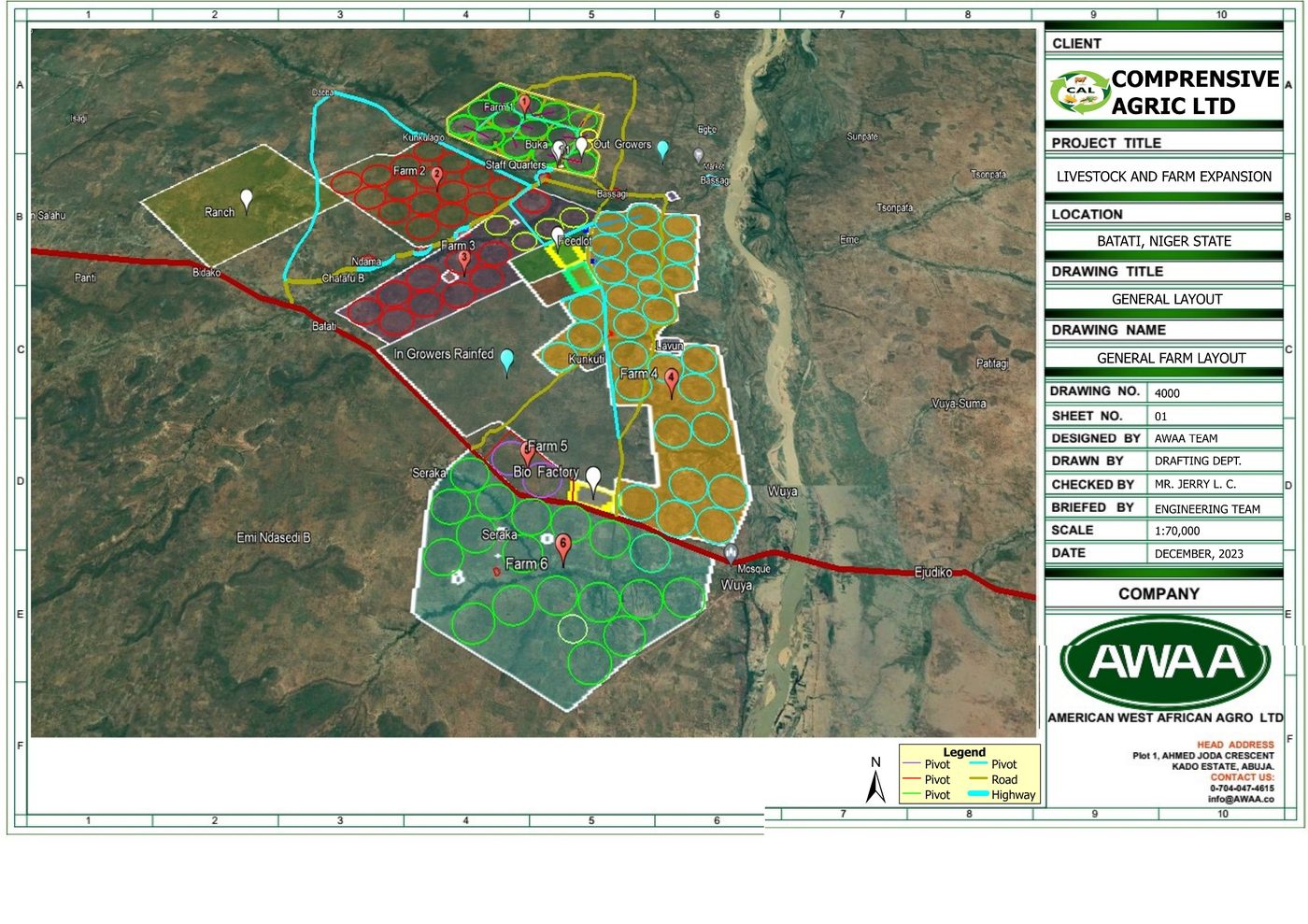
Anchored at Batati in Niger State, with sugar and grain irrigation extending into Kwara State — designed as a single, closed-loop enterprise from farm to finished product.
Corporate Vehicle & Location
Comprehensive Agric Limited is a Nigerian-incorporated special-purpose company established to develop, own and operate the integrated complex. It holds the underlying agricultural concession, all processing assets, livestock inventory, intellectual property and offtake arrangements.
Site selection at Batati and the Kwara extension is driven by topography and soils suited to large-pivot irrigation, strong surface and groundwater availability, proximity to the logistics corridors connecting north-central Nigeria with the Lagos and south-west consumer markets, established community relationships through AWAA, and a lower conflict-risk profile than parts of the north-east and middle-belt.
The Integrated Model
CAL's strategy is an end-to-end cluster in which every output becomes another process's input — reducing costs, smoothing cash flow and multiplying revenue streams.
Delivery Plan
The project is delivered in five phases to manage execution and capital risk, moving from foundation works to full nameplate operations.
| Phase | Timing | Key deliverables |
|---|---|---|
| 1 · Foundation | Year 1 | Headquarters, land preparation, first 5,000 ha pivot irrigation, port clearing of imported equipment, feedlot foundations, processing-plant pad works. |
| 2 · Ramp | Year 2 | Sugar mill construction, irrigation expansion, first feedlot cycle, bio-processing site works. |
| 3 · Commercial Operation | Year 3 | Sugar mill commissioning, feedlot at full throughput, ethanol & biodiesel start-up, meat packing plant online. |
| 4 · Optimisation | Years 4–5 | Expansion of sugar and ethanol, dairy operations, fresh-pack plant, full outgrower scheme. |
| 5 · Maturity | Years 6–7 | Full operational capacity and peak production across all assets. |
Implementation Timeline
Definitive equity and debt close.
Headquarters and access roads established.
First centre-pivot installations operational.
Feedlot phase-1 cattle placed on feed.
Mill mechanical completion; first sugar produced and dispatched.
Ethanol distillery commissioning; meat packing plant operational.
All assets operating at full capacity.
Market Opportunity
Structural demand, consistent government policy support and a chronic supply gap create a compelling case for integrated agribusiness at scale.
Nigeria imports the large majority of its sugar — around 1.7 million tonnes in 2024/25. The National Sugar Master Plan, extended to 2033, targets self-sufficiency through backward-integration mandates and incentives for greenfield complexes — the environment CAL is built for.
Domestic dairy meets only about 40% of demand — Nigeria spends roughly US$1.5 billion a year on dairy imports. Modern feedlot beef offers higher yield, predictable supply and better food safety than traditional herding, aligned with the National Livestock Transformation Plan.
Chronic grid deficits and high diesel costs make on-site biogas and co-generation valuable. Nigeria's ethanol-blending policy ambition (E10) and growing industrial demand support the distillery and biodiesel plant.
The Confidential Information Memorandum covers the complete project plan, financial model and returns profile, distributed on a named-recipient basis.
Contact us